
1. Search strategy
To identify articles on resistance, persistence, or tolerance to aPDT, a comprehensive literature search was conducted across multiple databases, including PubMed. Given the relatively limited attention this subject has received till now (especially compared to antibiotic resistance), no date restrictions were imposed; consequently, even the earliest relevant publications were considered. The search strategy involved keywords such as “antimicrobial photodynamic therapy”, “photodynamic antimicrobial chemotherapy”, “light-based antimicrobial therapy”, “photo-controlled antimicrobial therapy”, “antimicrobial photo-inactivation”, “sub-lethal”, “sub-effective”, “tolerance”, “resistance”, “susceptibility”, “persistence”, “successive”, “cycles”, “antibiotics”, “synergism”, “cross-resistance”, “cross-tolerance”, “virulence”, “toxin”, “biofilm formation”, “quorum-sensing”, “inflammation”, ‘immune system”, “macrophage”, “neutrophil”, “microbiota”, “dysbiosis”, “microbiome” and related synonyms. Both original research articles and reviews were included. Relevance was determined by screening titles, keywords, and abstracts. Studies were selected if they addressed tolerance, resistance, persistence, changes in susceptibility, or adaptive responses to repeated and/or sublethal aPDT exposures. Additionally, the reference lists of included articles and subsequent citations were analysed to identify further pertinent studies.
2. Study selection
In total, 21 research works on “PDI resistance/tolerance/persistence” were included, published between 2000 and 2025 (Fig. 1). Many studies have investigated the potential side effects of sub-lethal doses of other light-based treatments, including aBL therapy, cold atmospheric plasma therapy, ultraviolet light therapy, near-infrared light therapy, and red-light therapy. However, in most cases, such treatment approaches were considered outside of the scope of this review. In the present work, we included papers covering aPDT treatment against bacteria, fungi, and viruses; however, studies on the PDI of parasites were excluded. Only experimental studies reporting phenotypic, genetic, or molecular outcome measurements were included. Both studies, whether in vitro or in vivo, using animal, bacterial, or human cell lines, or in vivo assessments of PDT in animal or human models, were included. Studies without direct antimicrobial assays could be included if the considered field of application was antibacterial. For combinatorial approaches, only articles in which the effect was dependent directly on the PS were taken into account. Only studies in which the light irradiation step was necessary to observe the effects of interest were taken into account.
Several research papers and reviews on the induction of resistance, tolerance, or persistence to PDI following sub-lethal doses of aPDT have been published throughout the years. This includes three thorough papers by Rapacka-Zdończyk (2025), Surur et al. (2023), and Rapacka-Zdończyk et al. (2021). The former highlights bias across studies, while the latter proposes a methodology and guidelines for investigating potential resistance to PDI. Selected experimental papers on the investigation of susceptibility, tolerance, resistance, and persistence of microorganisms to sub-effective aPDT are summarized in Fig. 1. The latter depicts a temporal evolution, where the observed increase may not signify an actual rise, but is more plausibly explained by heightened interest in the subject. Regarding this matter, we considered experimental publications that applied multiple rounds of sub-lethal aPDT (Table 1). For other side effects of aPDI treatment, namely cross tolerance to aPDT mediated by other PS, changes in antibiotic susceptibility, metabolic and virulence-associated traits, and immunomodulation, selected research papers are summarized in Tables 2-5, respectively. For those investigated traits, a singular exposure to aPDT was accepted. It should be noted that this paper is not intended as a comprehensive review of the field, but rather as an overview of the effects of sub-lethal doses of aPDT.
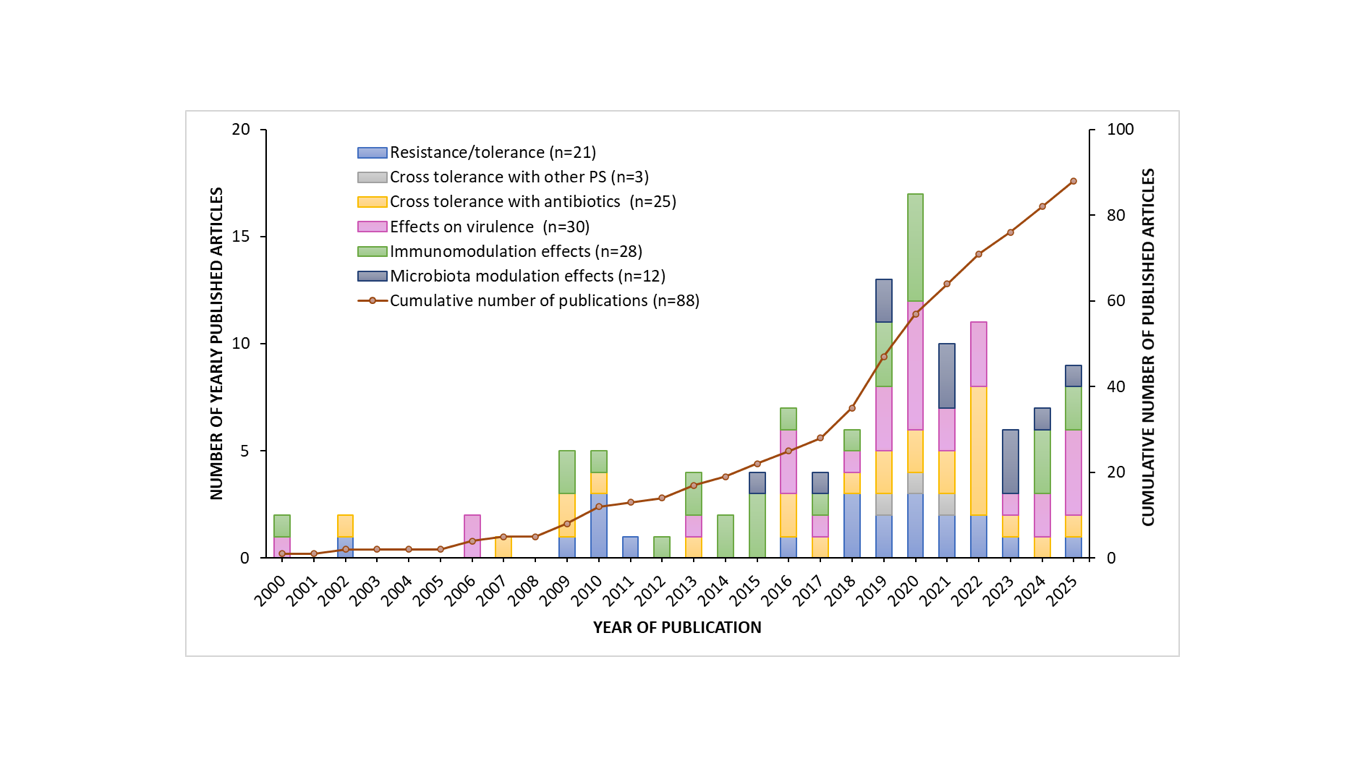
Since 2000, the total number of selected research papers on genetic, transcriptomic, and phenotypic responses to aPDT is eighty-eight. Twenty research papers and one thesis assessed the emergence of resistance/tolerance and persistence to aPDT following successive cycles of sub-inhibitory antimicrobial photodynamic inactivation (aPDI). Of those studies, three investigated the possibility of a cross-tolerance with structurally similar or different photosensitizers (PS). Twenty-five evaluated changes in antibiotic susceptibility following single or multiple aPDT exposures. Thirty, twenty-eight, and twelve research papers investigated the impact of aPDI on virulence and virulence-associated traits, immunomodulatory effects, and microbiota modulation, respectively.