Plus de 4 000 souches de moisissures, levures et bactéries
Le CRB FAN (Fungi Agri-food eNvironment) héberge et distribue majoritairement des champignons filamenteux et des levures isolés de différents substrats et environnements et issus majoritairement des projets de recherche du LUBEM (EA 3882 USC INRAe 1504). Plus de 60% de la collection est ouverte à la distribution.
Ressources Biologiques hébergées au sein du CRB FAN de l'UBOCC.
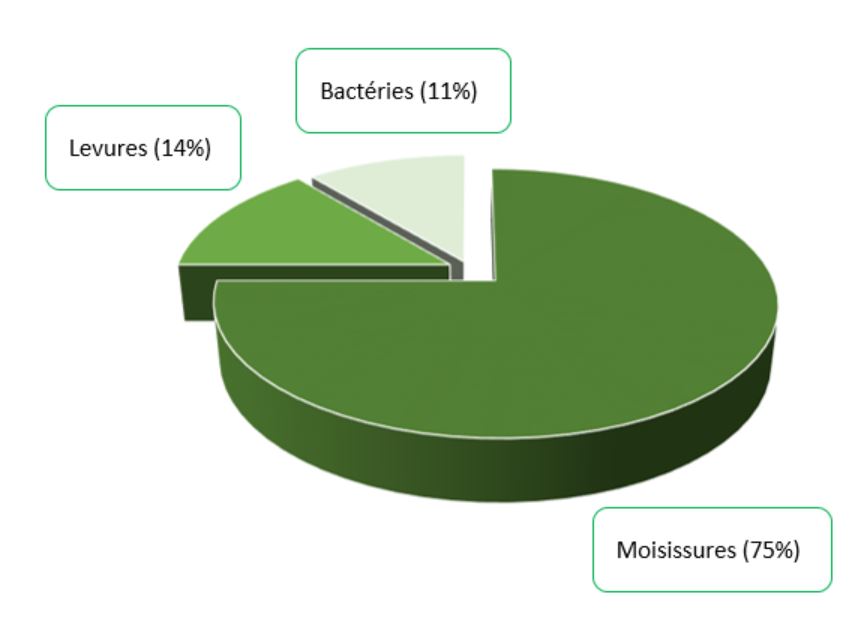
Quelques exemples de genres
Moisissures : Penicillium spp. - plus de 650 souches préservées, Fusarium spp. - plus de 400 souches préservées , Aspergillus spp. et Eurotium spp. - plus de 300 souches préservées, Colletotrichum spp. - plus de 150 souches préservées, Mucor spp. - plus de 150 souches préservées, Paecilomyces spp., Geotrichum spp., Trichoderma spp., Bisifusarium spp., Alternaria spp. ...
Levures : Candida spp., Rhodotorula spp., Debaryomyces spp., Saccharomyces spp., Cryptococcus spp.....
Bactéries : Bacillus spp., Pseudomonas spp., Lactobacillus spp.....
Substrats d'origine des Ressources Biologiques hébergées au sein du CRB FAN de l'UBOCC
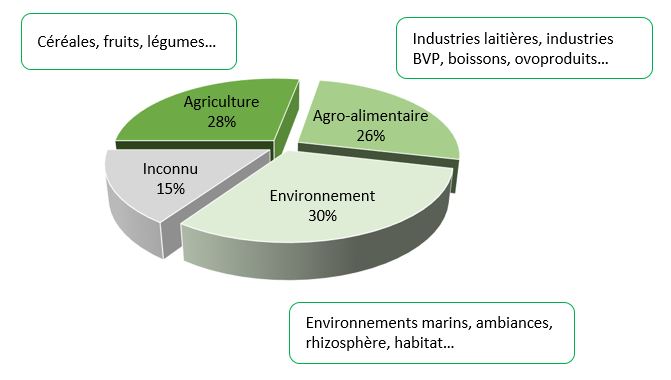
Quelques exemples de substrats d'origine
Agriculture : Fuits (pommes, abricots, agrumes, bananes, fruits à coques, tomates), légumes, plantes (tomates, oeillets, begonia)....
Agroalimentaire : Pains au lait, pains demi, produits laitiers, jus de fruits, thé, farines, miel, confiture, produits carnés, ovoproduits....
Environnement : Ambiances, habitats, milieux marins, bois, cosmétiques, sols....
Le CRB FAN fait partie du pilier microorganisme de RARe depuis le 31 mars 2022

Le CRB FAN est labellisé IBiSA depuis 2021

Le CRB FAN certifié ISO9001:2015 depuis 2021
Projet ProMedFood (2017-2021, projet européen LUBEM)
Promouvoir les aliments fermentés méditerranéens grâce à une meilleure connaissance de leur diversité microbienne (Projet Européen ERANET-Arimnet2, 7 partenaires de 6 pays)
Les objectifs de ce projet étaient :
- d’étudier et caractériser la diversité microbienne associée à 7 produits fermentés traditionnels du bassin Méditerranéen et leur dynamique au cours de la fabrication via des approches culture-dépendantes (i.e. préservation des ressources microbiennes isolées dont une partie à l’UBOCC) et -indépendantes (i.e. métabarcoding et métagénomique),
- d’identifier et sélectionner des souches dominantes bénéfiques
- et de mettre à profit ses souches lors d’études chez des producteurs artisanaux pour améliorer le contrôle de la fermentation et la qualité des produits.
L’ensemble de ces résultats ont contribué à une connaissance approfondie de la diversité taxonomique et fonctionnelle des microorganismes autochtones des aliments fermentés traditionnels
Valorisation scientifique : 4 publications ACL, 4 publications en révision, 5 communications orales, 10 communications affichées, évènements grand public : fête de la science, Nuit Européenne des chercheurs.
Penland, M., Falentin, H., Parayre, S., Pawtowski, A., Maillard, M. B., Thierry, A., ... & Deutsch, S. M. (2021). Linking Pélardon artisanal goat cheese microbial communities to aroma compounds during cheese-making and ripening. International Journal of Food Microbiology, 109130.
Penland, M., Deutsch, S. M., Falentin, H., Pawtowski, A., Poirier, E., Visenti, G., ... & Coton, M. (2020). Deciphering microbial community dynamics and biochemical changes during Nyons black olive natural fermentations. Frontiers in microbiology, 11.
Franciosa, I., Alessandria, V., Dolci, P., Rantsiou, K., & Cocolin, L. (2018). Sausage fermentation and starter cultures in the era of molecular biology methods. International journal of food microbiology, 279, 26-32.
Boussekine, R., Merabti, R., Barkat, M., Becila, F. Z., Belhoula, N., Mounier, J., & Bekhouche, F. (2020). Traditional Fermented Butter Smen/Dhan: Current Knowledge, Production and Consumption in Algeria. Journal of Food Research, 9(4).
Projet SpectroFUN (2015-2018, Thèse CIFRE LUBEM)
Les champignons filamenteux sont une cause majeure de l’altération des denrées alimentaires et de ce fait, sont responsables de pertes alimentaires et économiques. Certaines espèces produisent des mycotoxines pouvant représenter un danger pour la santé humaine et animale. Le management de la qualité sanitaire des aliments repose notamment sur une bonne connaissance des espèces fongiques en cause et une identification fiable et rapide de celles-ci. Dans ce contexte, l’objectif de ce projet impliquant le LUBEM et un industriel a été de développer la spectrométrie de masse Maldi-ToF pour permettre leur identification avec la construction d’une base de données robuste comprenant 6500 spectres issus de 136 espèces de moisissures représentées par 618 souches de l’UBOCC. Le potentiel de la technique pour l’identification d’espèces appartenant à des complexes d’espèces et la différenciation de souches issues de populations génétiques distinctes a également été mis en évidence.
Quéro, L., Courault, P., Cellière, B., Lorber, S., Jany, J.-L., Puel, O., et al. (2020). Application of MALDI-TOF MS to species complex differentiation and strain typing of food related fungi: Case studies with Aspergillus section Flavi species and Penicillium roqueforti isolates. Food Microbiology 86, 103311. doi:10.1016/j.fm.2019.103311.
Quéro, L., Girard, V., Pawtowski, A., Tréguer, S., Weill, A., Arend, S., et al. (2019). Development and application of MALDI-TOF MS for identification of food spoilage fungi. Food Microbiology 81, 76–88. doi:10.1016/j.fm.2018.05.001.